The Medicine Buddha: history and iconography
Where the blue Buddha comes from, how to recognise him, and why each country painted him in its own way.
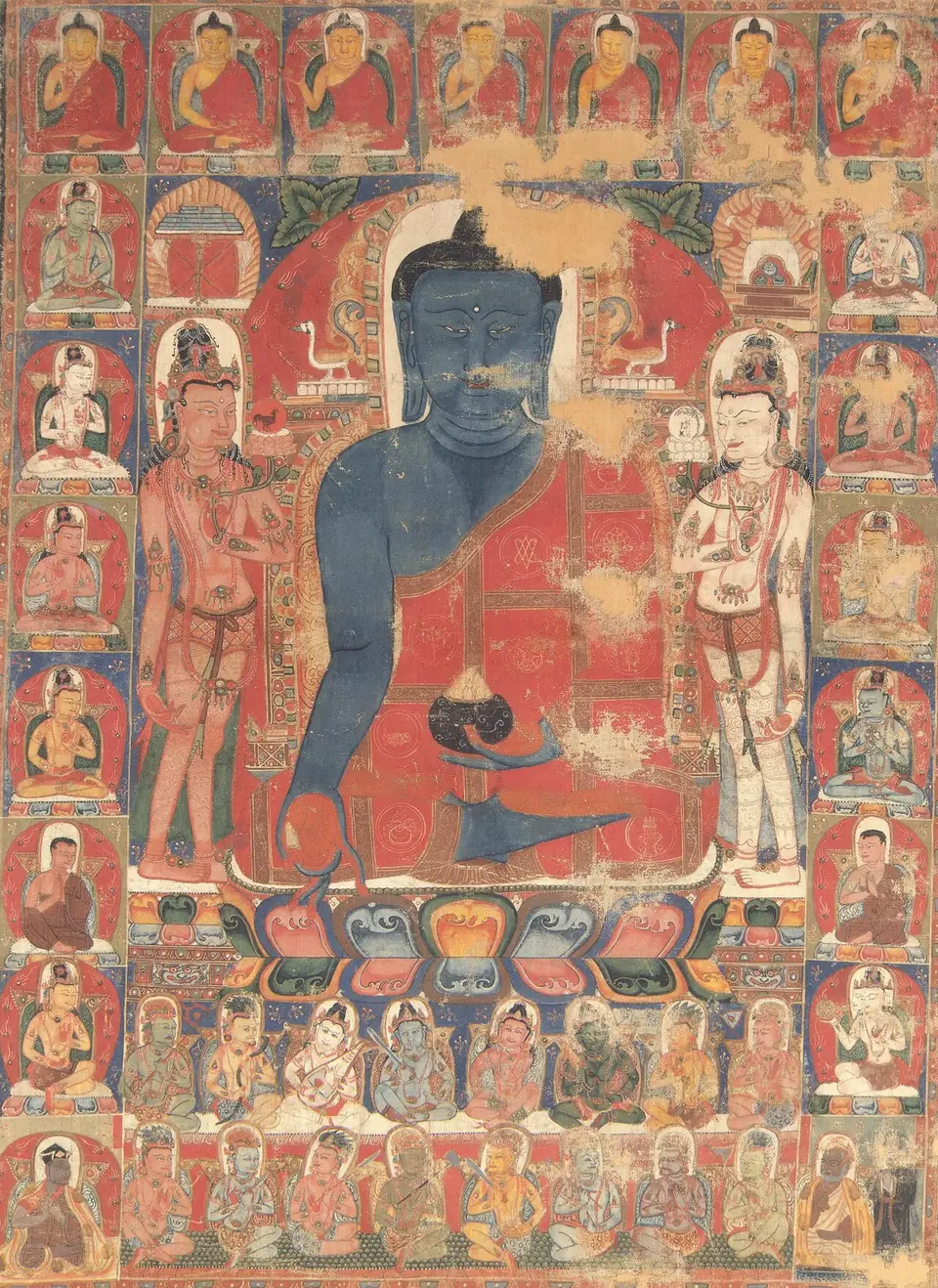
Iconography shows a Buddha whose body glows like a blue stone shot through with light, seated on a lotus, a bowl in his hand. He is not found in the earliest Buddhist texts: he appears later, in the Great Vehicle (Mahāyāna), as a figure turned towards the relief of suffering. His Sanskrit name, Bhaiṣajyaguru, means “master of remedies”; his full name, Bhaiṣajyaguru-vaiḍūrya-prabhā-rāja, “king of lapis lazuli light, master of remedies”.
A text found in the Himalayas
His founding text, the Medicine Buddha Sūtra, has not survived in translation alone. A Sanskrit manuscript on birch bark, copied around the 6th–7th century, was found in 1931 near Gilgit, in present-day Pakistan, with other Buddhist texts; Nalinaksha Dutt edited it in 1939. It is the most direct proof that the cult was already travelling the roads of Central Asia. The sūtra was then translated into Chinese several times, notably by Xuanzang in 650 and by Yijing in 707, and it is also part of the Tibetan tradition. The details are in the article on the sūtra.
How to recognise him
- A deep blue body, which the sūtra compares to lapis lazuli (vaiḍūrya). In some images, notably in China and Japan, the body is golden.
- A seated meditation posture, legs crossed, on a lotus.
- In the left hand, resting in the lap, an alms bowl or a medicine jar: the bowl of nectar.
- In the right hand, turned downwards in the gesture of giving, often a branch of myrobalan (arura), a fruit of Asian pharmacopoeias.
- Blue hair, a bump on the crown of the head (uṣṇīṣa) and the robe of a monk.
One Buddha, many faces
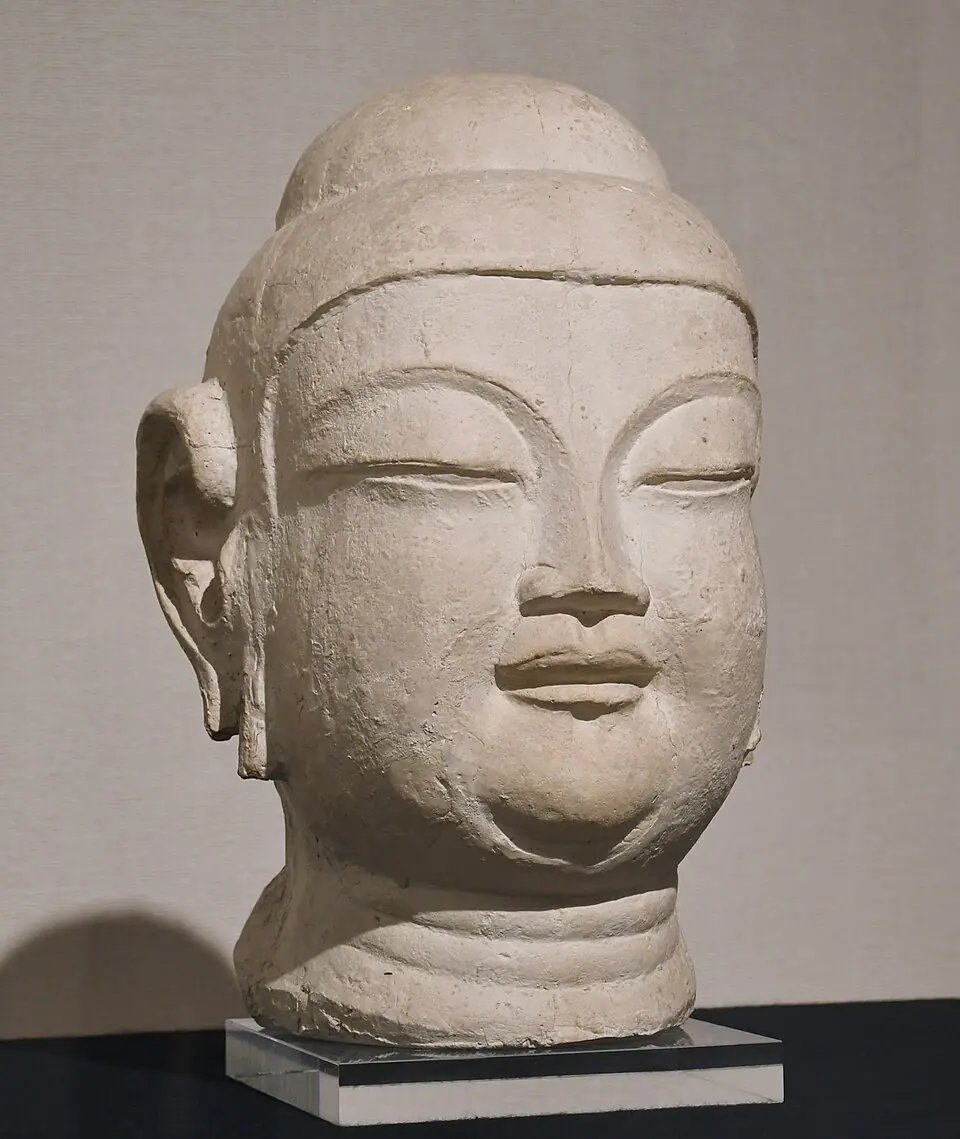
In Tibet, Sangye Menla is painted in intense blue, surrounded by the seven other Medicine Buddhas in the “group of eight” compositions. In China, Yaoshi Fo takes his place in the main hall of temples, often in a triad with Śākyamuni and Amitābha. In Japan, Yakushi Nyorai often holds a small medicine jar in his left hand; he is attended by two bodhisattvas, Nikkō (sunlight) and Gakkō (moonlight), and guarded by twelve heavenly generals. In Korea he is Yaksa Yeorae; in Vietnam, Phật Dược Sư. The article Journey through the countries follows this migration step by step.
The two companions and the retinue
The sūtra names two leading bodhisattvas: Universal Radiance of the Sun and Universal Radiance of the Moon. In China they are called Riguang (日光) and Yueguang (月光), in Japan Nikkō and Gakkō, in Tibet Sūryaprabha and Candraprabha (English-language catalogues also write Suryabhaskara and Chandrabhaskara). With them, the Buddha forms a triad: this is the layout of the great bronzes of Yakushi-ji in Nara. Around the triad there are often the twelve yaksha generals, protectors of the sūtra, and sometimes the seven or eight Medicine Buddhas.
The mandala of fifty-one deities
The Tibetan tradition developed a full Medicine Buddha mandala. Specialists of Himalayan art count fifty-one figures in it: at the centre, the Medicine Buddha, or the goddess Prajñāpāramitā in some versions; then an inner circle of eight Buddhas (the seven Medicine Buddhas and Śākyamuni), sixteen bodhisattvas, ten guardian deities of the directions, the twelve yaksha generals and the four guardian kings. These mandalas were painted on a single cloth or in series, each figure on its own painting; in China, embroidered sets were also made. The twelve generals of the outer circle are often misidentified in catalogues, sometimes taken for Jambhala or Kubera.
The hand gestures
- In Tibet: the right hand, resting on the knee, palm outward, makes the gesture of giving (varada) and holds a stem of myrobalan (arura, Terminalia chebula). The left hand, in the lap, holds a bowl of nectar. Tibetan medical treatises present arura as a major plant of their pharmacopoeia.
- In China: the same layout appears, but also a Buddha holding a pagoda or a pearl, and paintings where he carries a pilgrim’s staff. In main halls he often appears in the triad of the “three Buddhas”, with Śākyamuni at the centre and Amitābha on the other side.
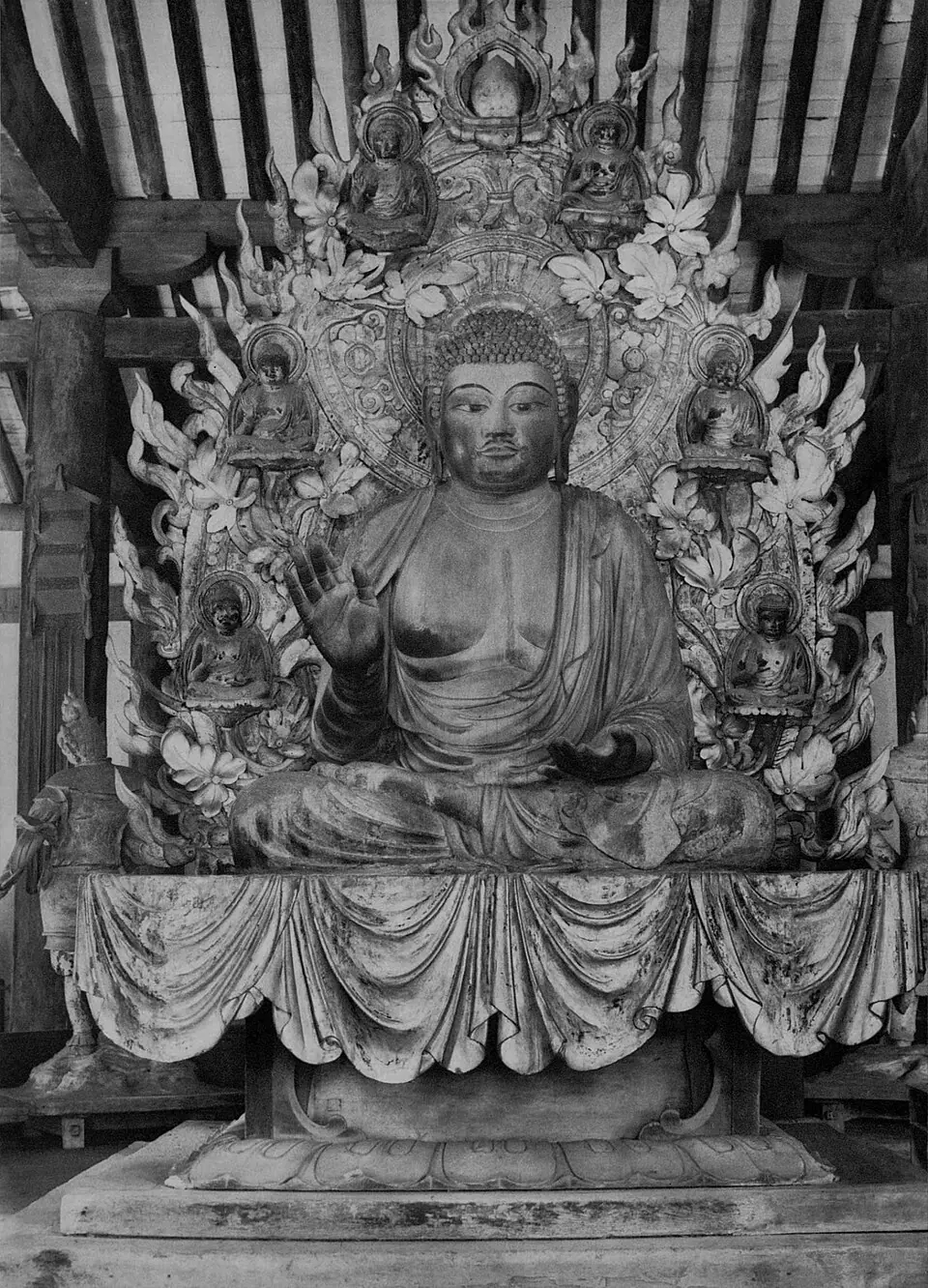
- In Japan: the right hand makes the gesture that removes fear (semui-in), the left the gesture of giving (yogan-in) while holding a small medicine jar (yakko). The oldest statues, such as those of Yakushi-ji and Tōshōdai-ji, have no jar: it became common after the arrival of a ritual manual attributed to Amoghavajra.
Some milestones in art history
- Gilgit (6th–7th century): Sanskrit manuscripts of the sūtra, found in 1931, attest the text’s circulation in Central Asia; see the Gilgit discovery.
- Dunhuang: the Mogao caves hold many wall paintings of the Medicine Buddha’s pure land, under the Sui and Tang. They show his pure land, the vows and the nine untimely deaths, painted as scenes.
- Japan, 7th–8th century: the statue in the Kondō of Hōryū-ji and the Yakushi-ji triad show the cult’s importance at court; see the Hōryū-ji inscription.
- Khara-Khoto (12th–13th century): Tangut paintings, now in the Hermitage Museum, mix Chinese and Tibetan styles; see Khara-Khoto.
- Tibet, late 17th century: under the regent Desi Sangye Gyatso, a series of medical plates opens with the image of the Medicine Buddha; see Desi Sangye Gyatso.
Colours and materials
The blue of the body comes from lapis lazuli in the sūtra, but painters used, depending on the period, azurite, ground lapis or other pigments. In Chinese, Japanese and Korean bronzes, the body is most often gilded, or left as dark metal as at Yakushi-ji. In Korea, many statues from the Unified Silla period hold the medicine jar in the left hand. For materials and pigments, see the article on thangka.
Do not confuse
Several figures look like the Medicine Buddha. Akṣobhya is also blue and linked to the east, but he touches the earth with his right hand and holds no medicine bowl. Bhaiṣajyarāja, the “king of remedies” of the Lotus Sūtra, is a bodhisattva, not a Buddha. Museum catalogues sometimes mix these images up; see the article on Bhaiṣajyarāja.
Reading a Medicine Buddha thangka, step by step
- Start at the centre: a blue Buddha, seated, in monk’s robes. Check the hands: the right hand gives (palm outward, often with the myrobalan stem), the left holds the bowl.
- Look at the two standing or seated figures on either side: the bodhisattvas of the sun and the moon, often with a sun disc and a moon crescent.
- Around and above: the seven other Medicine Buddhas, each with his own colour and gesture, sometimes with Śākyamuni among them.
- At the top, many paintings show teachers of the lineage; at the bottom, protectors, including the twelve yaksha generals, and sometimes the donors who commissioned the work.
- On the back, an old thangka may carry a consecration mantra in Tibetan script. Its presence says the painting was used in practice.
The seven Buddhas on Japanese halos
In Japan, the halo of a Yakushi statue often carries six or seven small seated Buddhas of the same size. They represent the seven Medicine Buddhas of Yijing’s version, understood as Yakushi and his emanations. This detail helps tell a Yakushi from another Buddha when the hands or the jar have been lost or replaced.
Common misconceptions
- The blue body does not prove the painting uses lapis lazuli: many blues are azurite or later synthetic pigments.
- The Medicine Buddha is not a historical person: he is a Buddha described in a Mahāyāna sūtra.
- Tibetan tradition presents the Four Medical Tantras as taught by an emanation of the Medicine Buddha in the city of Tanaduk; this is a teaching framework, not a historical date. See the Four Tantras.
Three works to see in person
- Dunhuang, Mogao Cave 220: the north wall, painted in the 640s, shows the pure land of the Medicine Buddha with seven standing Buddhas, musicians and dancers. It is one of the oldest large images of the Medicine Buddha’s world in China.
- Gyeongju National Museum, Korea: a gilt-bronze standing Yakushi from Baengnyulsa temple, of the 8th century (Unified Silla), is listed as National Treasure. Its hands are lost, which shows how hard it can be to name a statue once its attributes are gone.
- Nara, Yakushi-ji: the bronze triad of the Golden Hall, with Nikkō and Gakkō, is one of the masterpieces of East Asian bronze casting. The pedestal of the central Buddha is decorated with motifs that recall the routes linking Japan to China and Central Asia.
In Mongolia, the sculptor Zanabazar (1635–1723) and his school created gilt-bronze Buddhas whose style remains a reference; see the Zanabazar school.
The seven Medicine Buddhas and their names
Yijing’s sutra (T. 451) and the Tibetan text of the seven Tathāgatas (Toh 503) list the seven Medicine Buddhas. The Sanskrit names most often used in Tibetan rituals are:
- Suparikīrtitanāmaśrī, “Glorious Renowned Name”;
- Svaraghoṣarāja, “King of Melodious Sound”;
- Suvarṇabhadravimala, “Stainless Excellent Gold”;
- Aśokottamaśrī, “Supreme Glory Free from Sorrow”;
- Dharmakīrtisāgaraghoṣa, “Melodious Ocean of Dharma”;
- Abhijñārāja, “King of Higher Knowledge”;
- Bhaiṣajyaguru, the Medicine Master himself.
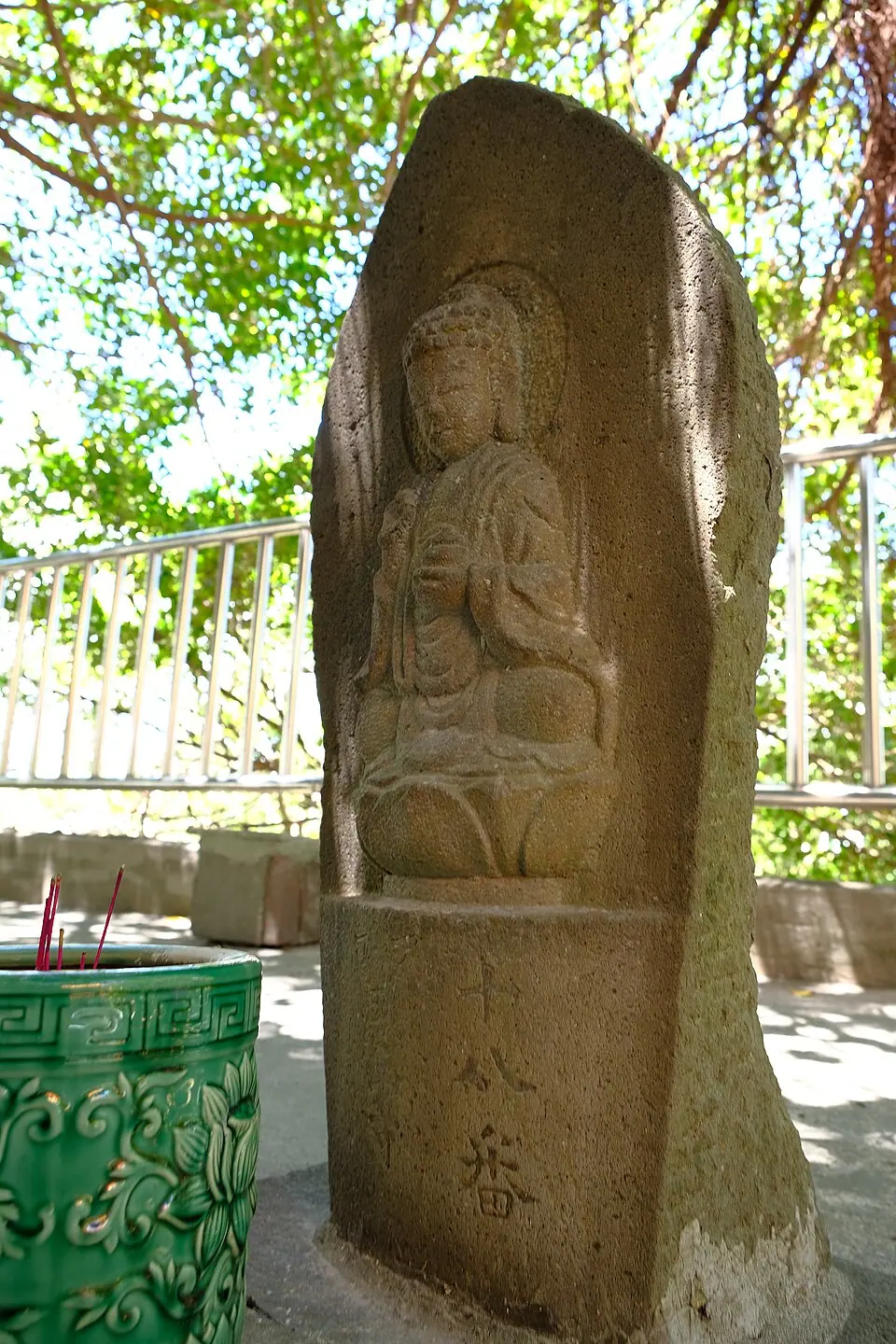
With Śākyamuni they make up the “Eight Medicine Buddhas” of Tibetan thangkas. The colours and gestures of each vary between lineages and workshops: the same name may be painted yellow in one set and red in another. To identify a figure, rely first on the inscription, when there is one, rather than on the colour.
The Blue Beryl and the medical paintings
In 1688 the regent Desi Sangye Gyatso completed the Blue Beryl (Vaiḍūrya sngon po), a major commentary on the Four Medical Tantras. Its title takes up the image of the Medicine Buddha, “king of beryl light”. To illustrate it he had a series of medical paintings made, usually counted as seventy-nine, which opens with the Medicine Buddha surrounded by his heavenly retinue. The paintings were used for teaching: anatomy, plants, diagnosis, diet. Old copies survive, notably at the Men-Tsee-Khang and in several museums. They show that in the Tibetan world the image of the Medicine Buddha opens the medical tradition without replacing it: it is the religious frame, not a prescription.
Where to see works in Europe
Several European museums show or publish online images of the Medicine Buddha: Tibetan thangkas, Nepalese bronzes, Chinese and Japanese sculpture. The Musée Guimet in Paris, the British Museum in London and the State Hermitage Museum in Saint Petersburg (paintings from Khara-Khoto) hold examples. Collections change and not every piece is on display: check the online catalogues before visiting. The site’s Works page gathers freely licensed images, each with its source and licence.
Going further
The statues and thangkas in the catalogue show these differences well. The sūtra and its commentaries are in the books section. The old paintings on this site (Tibetan thangka, Khara-Khoto painting, Chinese Yuan mural, Japanese Kamakura scroll) all come from museum collections, with credits in the legal notice.
Sources
- Himalayan Art Resources, Medicine Buddha
- Himalayan Art Resources, Medicine Buddha iconography
- Japanese Wikipedia, 薬師如来
- Raoul Birnbaum, The Healing Buddha (1979)
- Dunhuang Academy
Lapis is free and has no advertising. You can support its upkeep.