Who is the Medicine Buddha?
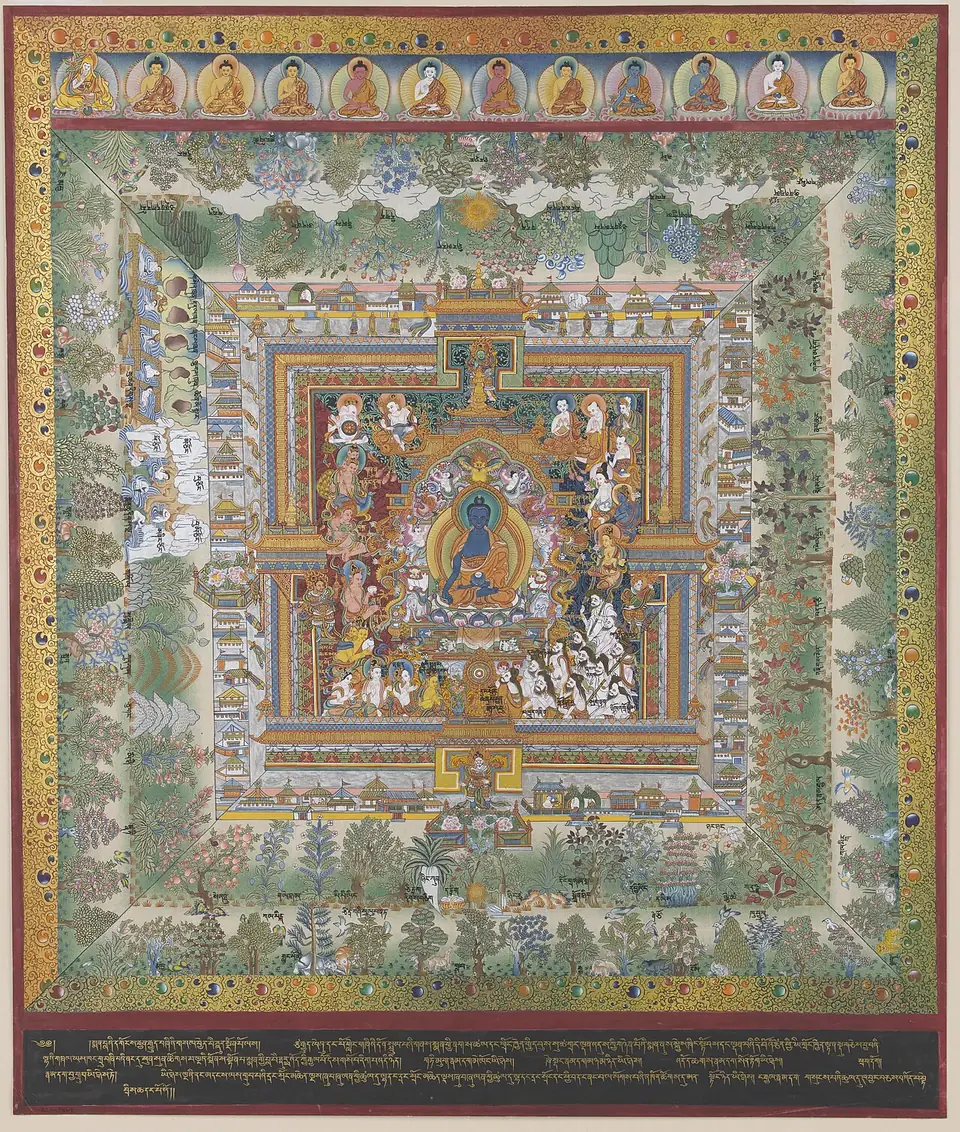
The Medicine Buddha is a figure of Mahāyāna and Vajrayāna Buddhism known by many names: Bhaiṣajyaguru in Sanskrit, Sangye Menla in Tibet, Yaoshi Fo (药师佛) in China, Yakushi Nyorai (薬師如来) in Japan, Yaksa Yeorae in Korea.
He is usually shown seated in meditation, his body blue like lapis lazuli, holding a bowl and sometimes a myrobalan branch. The text devoted to him, the Medicine Buddha Sūtra, describes twelve vows made for the benefit of all beings.
In Japan, many temples are dedicated to him, such as Yakushi-ji in Nara. In Tibet, his figure is closely linked to the medical tradition (Sowa Rigpa).
For some he is a figure of devotion; for others a work of art or a symbol of kindness. This site presents items related to him without taking sides.
All his names, language by language, in their own script and with sources: Bhaiṣajyaguru, Menla, Yaoshi, Yakushi: the names by country
Contents
- The peoples of the Medicine Buddha · His names · The mantra · The sūtra · The twelve vows · Iconography · Where to see him · History and research
One text, several translations
Almost everything we know about him comes first from a text, the Sūtra of the Master of Medicine (Bhaiṣajyaguru-sūtra). A Sanskrit manuscript was found at Gilgit (Pakistan) in 1931. In Chinese there are several translations: one attributed to Śrīmitra (4th century), Dharmagupta’s (615), Xuanzang’s (650), the most read, and Yijing’s (707), which speaks of seven Medicine Buddhas. Details are in the article on the sūtra and in the History and research section.
The Pure Land of lapis lazuli
The sūtra places him far to the east, in a “lapis lazuli” pure land (Vaiḍūryanirbhāsa), as Amitābha reigns in the west. He is flanked by two bodhisattvas, Sūryaprabha (sunlight) and Candraprabha (moonlight), and guarded by twelve yakṣa generals. See the Pure Land and the twelve generals.
How to recognise him
A blue body, seated in lotus posture, a bowl in the left hand; in Japan, often gilded. The details are in symbols and legends.
The mantra
The best-known mantra is “tadyathā oṃ bhaiṣajye bhaiṣajye mahābhaiṣajye bhaiṣajyarāja samudgate svāhā”. The full text, word-by-word meaning and country variants are in the mantra: text, meaning and use.
The twelve vows, in brief
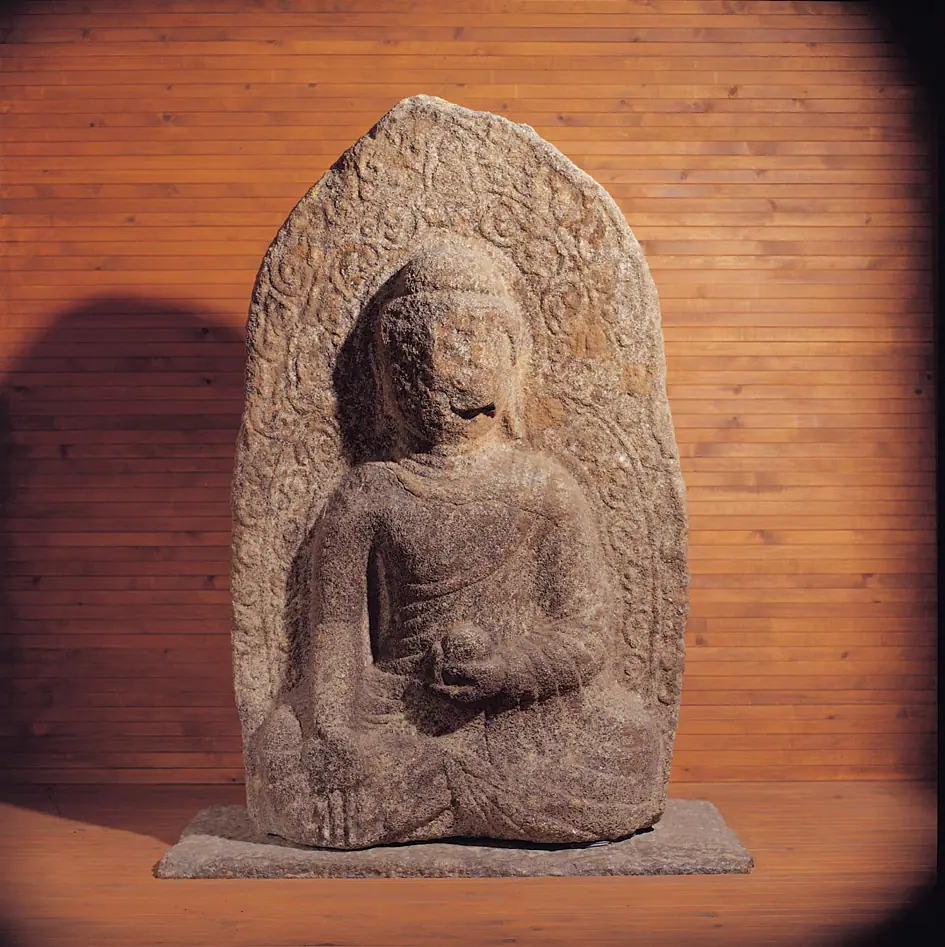
Before awakening, the bodhisattva makes twelve promises. Each vow begins “When I attain enlightenment…” and addresses a specific suffering: light and a lapis-lazuli body, that nothing be lacking, a right path, pure conduct, bodily completeness, refuge for the sick without support, freedom from fear and oppression, food and clothing. These are religious aspirations in the sūtra (Xuanzang’s translation, 650). Vow by vow: the twelve vows. See also the seven / eight Medicine Buddhas.
Lineages and traditions
- India and manuscripts — Sanskrit fragments at Gilgit (1931); see Gilgit and the sūtra.
- China — translations by Śrīmitra, Dharmagupta, Xuanzang, Yijing; Yaoshi Fo in temple halls; Chinese world.
- Tibet — Sangye Menla linked to Sowa Rigpa medicine; often the group of eight; History and research and Tibetan medicine.
- Japan — Yakushi Nyorai, Nara temples (Yakushi-ji, Shin-Yakushi-ji), medicine jar and gilded skin; Yakushi-ji, temples.
- Korea, Mongolia, Vietnam — Yaksa Yeorae, Otoch Manal, Dược Sư; see Korea, Mongolia, Places.
Practice and mantra
Tradition describes recitation with a mala, visualisation of the blue Buddha, and dedication of merit. Typical structure: preparation, refuge, mantra, dedication — see daily practice and setting up an altar. To hear the mantra: music; for a teacher: services.
Facts, debates and faith
Lapis separates what the sources allow us to affirm, what scholars still discuss, and what belongs to devotion. Start here: History and research (texts, archaeology, rituals, hypotheses). Sourced timeline: chronology of the cult.
Continue on Lapis
Catalogue · Places · Articles · Museums · Names by country
The seven and eight Medicine Buddhas
Yijing’s translation (707, Taishō 451[2]) describes seven Medicine Buddhas, each with a name, a pure land and vows. Bhaiṣajyaguru — “King of lapis lazuli light, master of remedies” — is the seventh. In Tibet the group of eight often adds Śākyamuni, or places Sangye Menla at the centre with seven companions. Common Sanskrit names (spellings vary):
- Suparikīrtitanāmaśrī — “Of perfectly glorious name”
- Svaraghoṣarāja — “King of melodious voice”
- Suvarṇabhadravimalaratna — “Pure jewel, fine as gold”
- Aśokottamaśrī — “Supreme glory free from sorrow”
- Dharmakīrtisāgaraghoṣa — “Voice of the ocean of Dharma glory”
- Abhijñārāja — “King of higher knowledges”
- Bhaiṣajyaguru-vaiḍūrya-prabhā-rāja — the lapis-blue Buddha
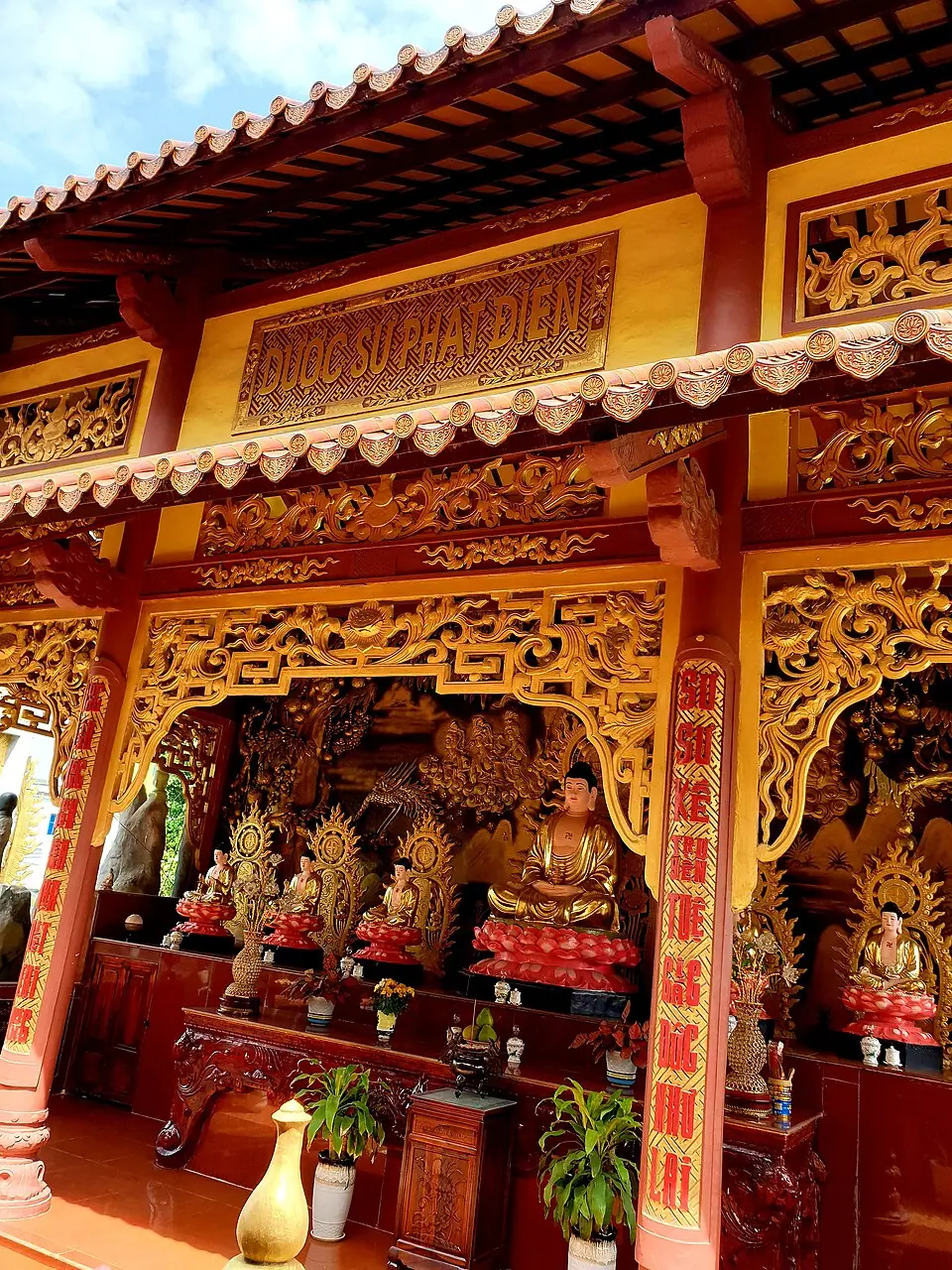
In Tibetan thangkas, colour and mudrā help tell them apart; lapis blue almost always marks Menla. More: the eight Medicine Buddhas · vows and seven Buddhas. In Japan: Shichibutsu Yakushi.
The mantra, word by word
Short form (Sanskrit): tadyathā oṃ bhaiṣajye bhaiṣajye mahābhaiṣajye bhaiṣajyarāja samudgate svāhā.
- tadyathā — “thus”, introduction
- oṃ — opening syllable
- bhaiṣajye bhaiṣajye — “remedy, remedy”
- mahābhaiṣajye — “great remedy”
- bhaiṣajyarāja samudgate — “king of remedies, arisen / exalted”
- svāhā — closing, “may it be so”
Literal translation is still debated: a mantra is first a transmitted sound. Common Tibetan pronunciation: “Tayata om bekandze bekandze maha bekandze radza samudgate soha”. In Buddhist reading, the “remedy” points first to the three poisons (desire, anger, ignorance), not to clinical treatment. Long form (dhāraṇī), variants and use: mantra and meaning. Sūtra quotations: Citations.
Ritual framing (what the traditions describe)
Texts and monasteries place the practice in several contexts — always as devotion or karmic purification, never as clinical medicine:
- illness and suffering: pujas and recitations dedicated for the sick (Tibetan FPMT-style centres and Sowa Rigpa lineages; Yakushi temples in Japan)
- the dying and the dead: in several Tibetan lineages, Medicine Buddha pujas accompany the forty-nine days after death — a symbolic transition period, not a medical rite
- animals and living beings: hearing the name or mantra framed as kindness toward all beings
- success in activities and Dharma: the sūtra vows also address fear, poverty and right conduct — hence a wide daily use
Typical short session: preparation, refuge, visualisation of the blue body, mala mantra, dedication. See daily practice, altar, services. Lapis does not sell healing and states clearly: this is not medical treatment.
The peoples of the Medicine Buddha
The Medicine Buddha does not belong to one single people. His tradition was born in north-western India, then travelled for centuries, carried by monks, merchants and translators who spoke very different languages. Here is who they were, with sources.
In short
- The sūtra is attested in the Gilgit manuscripts, near ancient Gandhāra (in what is now northern Pakistan), then travelled along the Silk Roads to China, Korea, Japan, Tibet, Mongolia and Nepal.
- It was carried by speakers of several language families: Indo-Aryan, Iranian, Tocharian, Sino-Tibetan, Koreanic, Japonic and Mongolic.
- These exchanges ran in several directions; no present-day people is its only heir.
The chapter in detail
Each part opens with one tap.
1. Where does he come from?
A Sanskrit manuscript of his sūtra is among the Gilgit manuscripts (found in 1931), in today’s northern Pakistan, near ancient Gandhāra, a crossroads of India and Central Asia[a]. From there, Buddhism followed the Silk Roads: Khotan, Kucha, the Sogdian cities, then China, Korea, Japan, Tibet, Mongolia and Nepal[b].
2. The language families
| Language family | Languages | Role |
|---|---|---|
| Indo-Aryan languages | Sanskrit, gāndhārī | Original texts |
| Iranian languages | Khotanese language, Sogdian language | Silk Roads |
| Tocharian languages | Tocharian A and B (Kucha, Turfan) | Buddhism of the Tarim Basin |
| Sino-Tibetan languages | Chinese language, Tibetan language, Newar language | Major translations, living practice |
| Koreanic languages | Korean language | Worship of the Medicine Buddha (Yaksa Yeorae) |
| Japonic languages | Japanese language | Worship of the Medicine Buddha (Yakushi Nyorai) |
| Mongolic languages | Mongolian language | Medicine Buddha (Otoch Manla) |
Sanskrit and Gāndhārī are Indo-Aryan languages[c]. Khotanese and Sogdian are Iranian languages, spoken by merchant and Buddhist peoples of Central Asia[d]. Tocharian, spoken in Kucha and Turfan, is a separate branch of Indo-European; most surviving texts in it are Buddhist[e]. Chinese, Tibetan and Newar (Nepal) are Sino-Tibetan languages; Korean, Japanese and Mongolian belong to three other families[f].
3. What genetics says (with caution)
Ancient DNA studies show that South and Central Asia were shaped by old and repeated mixing between populations[g]. The Tarim Basin mummies, from the region of Kucha and Khotan, descend mainly from a very old local population[h]. Tibetans carry a variant of the EPAS1 gene that helps them live at high altitude[i]. Present-day Japanese people have ancestry from three main ancient sources[j].
Important: a language, a culture or a faith is not passed on through genes. Human “races” are not reliable biological categories[k]. The Medicine Buddha tradition is passed on through teaching, texts and practice, and anyone can enter it.
4. Clothing
Monks wear the kāṣāya, a robe originally made of patches of cloth sewn together. Its colour and shape change from country to country: ochre or saffron in Southeast Asia, maroon and yellow in Tibet and Mongolia, grey, brown or black in China, Korea and Japan, where it becomes the kesa worn over a robe[l]. Lay people keep their local dress: the Tibetan chuba, the Mongolian deel, the Korean hanbok, the Japanese kimono[m].
5. Customs and practices
- Tibet and Mongolia: he is linked to Tibetan medicine (Sowa Rigpa); around 1720, the famous medical paintings of the regent Desi Sangye Gyatso bear the title “Ornament to the Mind of the Medicine Buddha”[n].
- China: people recite his sūtra and his name for health and long life[b].
- Japan: Yakushi-ji temple (Nara) was commissioned in 680 by Emperor Tenmu for the recovery of his consort, the future Empress Jitō[o]. The 8th of each month is his festival day (ennichi)[p].
- Nepal: Newar Buddhism keeps rituals in Sanskrit, passed on by vajrācārya priests[q].
- Art: everywhere he is blue like lapis lazuli, holds a medicine bowl and often a healing plant (myrobalan)[b].
6. The svastika, a sign of good fortune
The Sanskrit word svastika comes from svasti, “well-being, good fortune”[r]. It is a very ancient sign, sacred in Hinduism, Buddhism and Jainism[s]. In Buddhism it is a sign of good fortune and often marks Buddha images and temples[s].
- China: 卍 is read wàn, “ten thousand”, and stands for long life and endless happiness[r].
- Japan: manji (卍); on maps it marks a Buddhist temple[r].
- Tibet: yungdrung, a sign of the eternal, also important in the Bön religion[r].
- Korea and Mongolia: manja in Korean, khas in Mongolian[r].
We found no serious source linking the svastika to the Medicine Buddha in particular: it is a sign shared by all of Buddhism.
7. Crossroads: diagram and six regions
Crossroads: exchanges, not a one-way road
The Medicine Buddha tradition and the scholarly medicine later called Sowa Rigpa did not travel in a straight line. They grew at crossroads: the Indus valley, Gandhāra and Gilgit in what is now northern Pakistan, Tocharian and Khotanese cities of the Tarim basin, Greek and Iranian worlds meeting on the Silk Roads. The diagram below shows exchanges — both ways — rather than a one-way story.
Exchange diagram: every link runs both ways. No people sits alone at the centre.
1. Indus valley
Long before Buddhism, Harappa and Mohenjo-daro show dense urban life. The Medicine Buddha is not yet there. But it is on this South Asian ground that Ayurveda and other medical knowledges later took shape — knowledges that, centuries on, helped feed the Sowa Rigpa synthesis[1].
2. Northern Pakistan · Gilgit · Gandhāra
A Sanskrit manuscript of the Medicine Buddha sūtra comes from the Gilgit manuscripts (1931). Ancient Gandhāra — including Taxila — was a crossroads of India, Central Asia and the Hellenised world. Buddhist medicine and surgical instruments are documented there; studies compare Greek, Roman and Buddhist practices in the region[2].
3. Greek world · Asclepius (parallel)
Asclepius is the Greek god of medicine; his sanctuaries (Asklepieia) healed across the Hellenistic world. In Gandhāra, Greco-Buddhist art and culture show lasting exchange between Greek and Indian worlds[3]. Historians sometimes compare these neighbouring healing figures. No serious source proves a direct fusion with Bhaiṣajyaguru: it is a cultural parallel, not an identity[4].
4. Tocharians · Kucha · Turfan
Tocharian languages (A and B), spoken in the northern Tarim oases, left mainly Buddhist texts. Their medical vocabulary borrows heavily from Middle Indian and Iranian (often via Khotanese): evidence of north–south exchange in the basin, not of a single road[5].
5. Khotan · Sogdians
Khotan, an Iranian kingdom on the southern Tarim, translated and transmitted Ayurvedic texts (Siddhasāra, Jīvakapustaka) alongside Mahāyāna Buddhism. Sogdian merchants linked these oases westward and eastward. Medical knowledge travelled with caravans and monks[6].
6. Sowa Rigpa · plural synthesis
Sowa Rigpa (“science of healing”) is a scholarly synthesis: Ayurveda, Chinese contributions, Persian / Greco-Arabic learning and local materia medica. The Medicine Buddha is an important figure among others. No single people and no single court owns its origin alone[7].
Takeaway: the routes are networks. The peoples above passed on texts, plants, gestures and images. This chapter names historical peoples and regions; it does not rank any modern country above another, and it promises no cure.
Added sources
- Indus Valley Civilisation — Wikipedia · on Ayurveda and Taxila: Naqvi, A Study of Buddhist Medicine and Surgery in Gandhara
- Gilgit manuscripts · Naqvi, op. cit. · Taxila instruments (Marshall excavations)
- A. Foucher, L’Art gréco-bouddhique du Gandhâra (1905–) · Greco-Buddhism — Wikipedia
- Asklepios / Buddhist healing figures parallel: open scholarly discussion; no established equivalence with Bhaiṣajyaguru (Birnbaum, The Healing Buddha, 1979)
- Dragoni / Peyrot et al., “Materia Medica Tocharo-Hvatanica”, BSOAS — doi · Tocharian languages
- Emmerick / Maggi on Khotanese literature · Khotanese medical texts (Siddhasāra, Jīvakapustaka) · Sogdia — Wikipedia
- Medicine and Healing in Tibetan Societies (plural Sowa Rigpa synthesis) · Yang Ga / Kilty on Indian contributions
Sources for this chapter
- Gilgit manuscripts — Wikipedia · Birnbaum, The Healing Buddha
- Bhaisajyaguru — Wikipedia · R. Birnbaum, The Healing Buddha (1979)
- Indo-Aryan languages — Britannica · Gāndhārī — Wikipedia
- Khotanese · Sogdian — Wikipedia
- Tocharian languages — Wikipedia
- Glottolog, language families · Sino-Tibetan — Wikipedia
- Narasimhan et al., “The formation of human populations in South and Central Asia”, Science 2019 — doi
- Zhang et al., “The Bronze Age origins of the Tarim Basin mummies”, Nature 2021 — doi
- Huerta-Sánchez et al., “Altitude adaptation in Tibetans caused by introgression of Denisovan-like DNA”, Nature 2014 — doi
- Cooke et al., “Ancient genomics reveals tripartite origins of Japanese populations”, Science Advances 2021 — doi
- Statement on race and racism, American Association of Biological Anthropologists (2019)
- Kāṣāya — Wikipedia
- Chuba · Deel · Hanbok · Kimono — Wikipedia
- Four Tantras · Tibetan medicine — Wikipedia
- Yakushi-ji — Wikipedia
- 縁日 (ennichi) — Wikipedia JA
- Newar Buddhism — Wikipedia
- Swastika — Wikipedia
- Swastika — Britannica
Sources
- Sūtra of the Master of Medicine, Xuanzang (650) — Taishō 450 on CBETA
- Sūtra of the Seven Medicine Buddhas, Yijing (707) — Taishō 451 on CBETA
- Raoul Birnbaum, The Healing Buddha (Shambhala / Motilal, 1979/1989) — scholarly overview of the cult
- Bhaisajyaguru — Wikipedia (EN) · FR · 薬師如来 (JA)
- On Lapis: sūtra citations · sourced chronology · History and research
- Taishō 449 — CBETA
- Taishō 1331 (灌頂經, ch. 12) — CBETA
- 84000 — Toh 504
- 84000 — Toh 503
- Raoul Birnbaum, The Healing Buddha — Open Library