Yaoshi Fo in the Chinese world: caves, museums and temples
From Dunhuang to Taipei and Hong Kong, the Medicine Buddha, 藥師佛 Yàoshīfó, can be followed through translated sutras, wall paintings and temples that are still active.
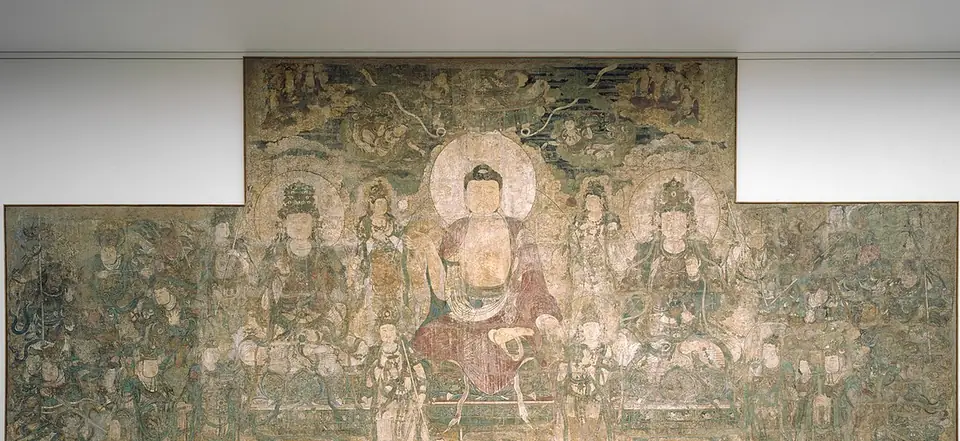
In Chinese the Medicine Buddha is called 藥師佛 (Yàoshīfó, simplified 药师佛) or 藥師琉璃光如來, “Tathāgata, master of remedies, light of lapis lazuli”. This article gathers a few places and objects documented by the institutions that keep them.
Translated sutras
According to a study by the National Palace Museum in Taipei, the Chinese Taishō canon contains sixteen texts devoted to the Medicine Buddha. The oldest is attributed to Śrīmitra (帛尸梨蜜多羅, 4th century); the most widely read is the version by Xuanzang (玄奘), and the most complete is that of Yijing (義淨), which presents seven Medicine Buddhas.
Dunhuang and Yulin
At the Mogao caves, cave 220 keeps a large “transformation tableau of the Medicine Buddha sutra” (藥師經變) from the early Tang. At the Yulin caves, the Dunhuang Academy describes in cave 19 a composition on the same subject dated to the Five Dynasties, with long-sleeve and pipa dance scenes; cave 25 holds an image of the Medicine Buddha from the mid-Tang.
In museums
The Palace Museum in Beijing keeps a painted leaf from Dunhuang (Five Dynasties, 34 × 30 cm): the Buddha, seated on a lotus, holds a bowl in his left hand and a ringed staff in his right. In Taipei, the National Palace Museum keeps an illustrated Ming manuscript of the sutra, and a Qing copy by Zhang Ruo’ai of Wen Zhengming’s calligraphy of the sutra.
Taiwan and Hong Kong today
The Medicine Buddha festival falls on the 30th day of the 9th lunar month, 8 November in 2026 (see festivals). In Hong Kong, Tsam Shan Monastery at Clear Water Bay has a Medicine Buddha hall open every day and announces a ceremony from 17 to 19 October 2026; in Tsuen Wan, the fifth floor of the Western Monastery pagoda is devoted to him, between the bodhisattvas Sunlight and Moonlight. The Chinese objects we have checked are gathered on the China page.
Uncertainties
The dates of the paintings are those given by the museums and may change with research. The origin of the 30th-of-the-9th-month date is not explained in the sources consulted.
Sources
- 敦煌研究院 dha.ac.cn, 榆林窟第19窟、第25窟
- 故宫博物院 dpm.org.cn, 药师如来像页
- 國立故宮博物院 npm.gov.tw, 康熙《龍藏經》中藥師佛文本與圖像
- digitalarchive.npm.gov.tw, 清張若靄臨文徵明藥師經
- 湛山寺 chamshanmonastery.org
- 西方寺 wm.org.hk
Lapis is free and has no advertising. You can support its upkeep.