Medicine Buddha mudra and what he holds: bowl, myrobalan, medicine jar
His hand gestures (mudrā) and objects change from Tibet to Japan: the bowl, the myrobalan fruit, the medicine jar, the staff. A sourced guide to reading a statue.
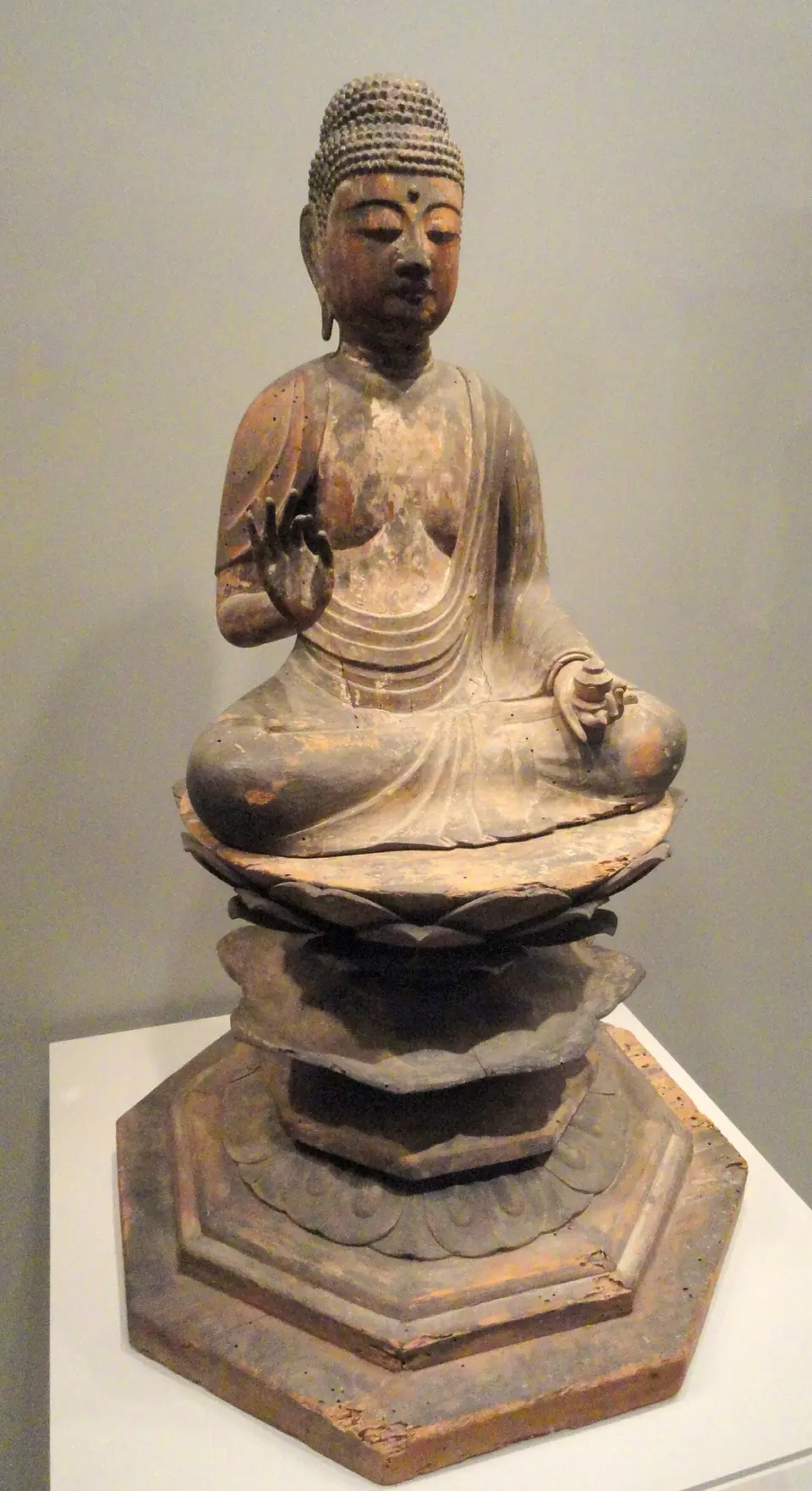
How do you recognise the Medicine Buddha? Less by his face than by his hands. Depending on the country and the century, his hands make different gestures (mudrā) and hold different objects. Here is how to read them, country by country.
In Tibet and the Himalaya: the bowl and the myrobalan
In Tibetan painting and bronze, the Medicine Buddha is seated, his body blue like lapis lazuli. His left hand rests in his lap in the gesture of meditation and holds a bowl, often filled with medicinal nectar. His right hand rests on his right knee, palm turned outward: this is the gesture of giving (varada mudrā). Between thumb and index finger it holds the stem of a myrobalan fruit (Terminalia chebula, called arura in Tibetan). This fruit is one of the most used plants of Tibetan medicine, which is why it became his sign.
In China: jar, bowl, staff or pagoda
In Chinese Buddhism, the usual image shows the left hand holding a medicine jar and the right hand in the gesture of "no fear" (abhaya mudrā: palm raised and turned outward) or in the gesture of giving. Under the Tang dynasty, a common form showed him with a monk's staff (khakkhara) in one hand and a bowl in the other. In temple triads, he may also hold a bowl, a small stupa (pagoda), a vase of nectar or a willow branch.
In Japan: the jar of Yakushi
In Japan, Yakushi Nyorai usually raises his right hand in the "no fear" gesture (semui-in) and lowers his left hand in the gesture of giving (yogan-in), holding a small medicine jar (yakko). But many early statues hold no jar at all, such as the Yakushi statues of the Golden Halls (Kondō) of Yakushi-ji and Tōshōdai-ji in Nara. According to Japanese scholarship, the jar became common after a ritual manual of Yakushi translated by Amoghavajra (8th century) reached Japan. A statue without a jar can therefore still be a Yakushi: look at the inscription, the temple, or the two attendants and the twelve generals around him.
In Korea and Vietnam
In Korea, Yaksa Yeorae usually holds a medicine container in his left hand, while his right hand makes the "no fear" gesture (simuoe-in). In Vietnam, images of Phật Dược Sư often show the left hand holding medicine and the right hand in the gesture of giving.
The seed syllable "bhai"
In Japanese esoteric Buddhism (Shingon and Tendai), each Buddha has a seed syllable (shuji), written in Siddham script. For Yakushi it is "bhai" (भै), the first sound of his Sanskrit name, Bhaiṣajyaguru. His symbolic object (sanmaya-gyō) is the medicine jar, or a bowl of pills.
Reading a statue in practice
- Blue body, bowl in the left hand, fruit in the right hand: Tibetan or Himalayan style.
- Small jar in the left hand, right hand raised: Chinese, Japanese or Korean style.
- No object, but two attendants carrying a sun and a moon: probably a Yakushi triad; see Sunlight and Moonlight.
- A small seated Buddha in metal, from Thailand, holding a pot: see the Phra Kring.
These signs are the language of images. They describe a figure. To go further, read Symbols and legends and How to choose a Medicine Buddha statue.
Sources
- Wikipedia, "Bhaisajyaguru" (iconography)
- Wikipedia (Japanese), "Yakushi Nyorai": gestures, jar, seed syllable
- Wikipedia (Chinese), "Medicine Buddha": Chinese and Tibetan forms
- Wikipedia (Korean), "Yaksa Yeorae"
- Wikipedia, "Terminalia chebula" (myrobalan)
- Himalayan Art Resources, Medicine Buddha main page
Lapis is free and has no advertising. You can support its upkeep.